


Inside the creative writing course offering incarcerated women choice, a voice, and hope.
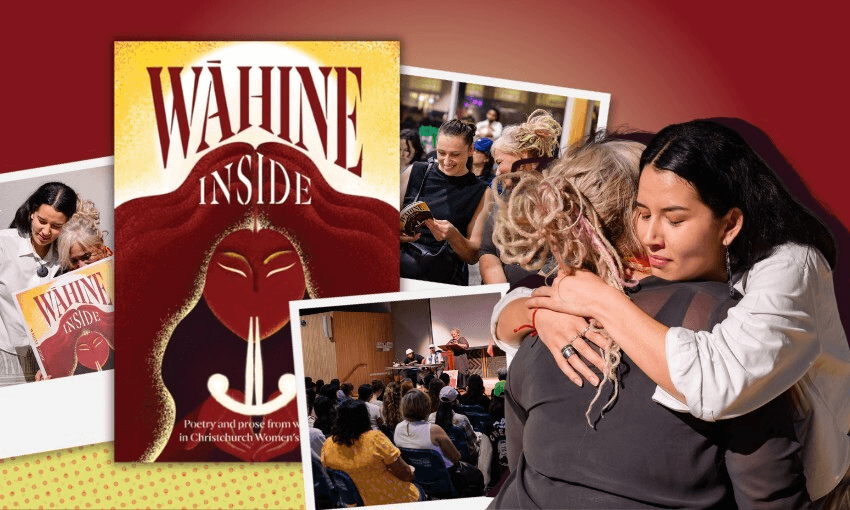
If you had told AW a year ago that she would be standing up on a stage receiving a standing ovation for her writing she’d have said you were lying. But on Friday, March 27, AW and fellow contributors, editors and project managers, launched Wāhine Inside: Poetry and prose from wāhine in Christchurch Women’s Prison. “It was overwhelming,” said AW. “To have all these people I respect and admire screaming at me, ‘We see you!’ I still get chills thinking about it.”
Wāhine Inside is a project led by Te Kāhui, a small but dynamic organisation that leads creative arts workshops in consultation with the communities they serve, from migrant and refugee rangatahi, to rangatahi and wāhine in prison. The book is stunning as an object: designer Kaan Hiini created texture by using scans of hand-written poems to weave throughout the typeset pages, and the cover image evokes the weight and feel of clay.
The tactile feel to the design is exactly what editorial advisor Deborah Smith wanted for the book. She loves that readers will get to see the hand-written pieces, the crossings out, the authors’ own hands processing ideas and emotions on the page. As a beneficiary of other creative writing programmes, Smith understands what it means to have the space to create. After her release from prison she continued writing to help process conversations on stigma, bias and the struggle of reintegration. The combination of these experiences meant Smith was uniquely qualified to midwife the women’s submissions to the book into a logical flow, and offer thoughts on how their work should be treated. “[The writing] felt fresh and real and authentic,” she said. “That is how we wrote in there. We didn’t have pads or booklets, but that didn’t stop us from writing poetry on scraps of paper.”

Wāhine Inside represents Smith’s first time as an editor. For her, finding the patterns across the submissions, which often stem from a prompt given in the writing workshops, revealed to her just how essential art programmes like Te Kāhui are for giving incarcerated women a voice. “It’s lifesaving,” she said. Smith feels blessed to have had the support of Sherry Zhang and Ruby Macomber, Te Kāhui’s co-managers, who gave Smith the confidence to trust her gut as she went through the editorial process, and to trust in the process.
Wāhine Inside has gifted Smith a community that understands the struggle of reintegration, of like-minded people who have, like her, discovered that everybody has the right to be heard, and that anybody can change. She hopes the book will help shift the landscape for incarcerated women in the minds of readers: “We’re not only the name of a crime,” she said.

AW agrees: “You don’t have to be the person you were. You’re not that person now.” This is what she hopes readers, particularly women either incarcerated or formerly incarcerated, will take from this book. As for other readers, AW wants them to remember who the authors really are: “They’re not statistics, or bad people who were locked up. They’re multifaceted women. They’re mothers and daughters, aunties and sisters.”
As for the writing itself, AW laughs when she recalls that her high school English teacher, who surprised her by turning up to the Auckland launch of the book, said it was ironic that it was poetry that brought her back into print. AW loved writing as a child but stopped for a long time. It was her high school English teacher who encouraged her talent for the written word, mainly essays. But in prison it was poetry that resonated with AW: “it’s a vessel for truth. It helps people articulate and process anger, trauma and grief in a way that doesn’t feel like a forced rehabilitation programme, or overly structured like therapy. Poetry allows you to deal with your damage on your own terms and in your own words in the way that you want.”
Hope
Hope looks like
closed minds
learning to open,
quiet and still.
– an excerpt from ‘Hope’ by AD in Wāhine Inside
Both Smith and AW are passionate about the necessity of programmes like Te Kāhui. Far from viewing creative arts and education as “nice-to-haves” they see them as essential to survival both inside prison and out. Both have gone on to study at tertiary level and credit the work they did in prison, as well as the ongoing support of their tutors and Te Kāhui staff, with helping their reintegration and continuing explorations of themselves as artists and creatives and people. “This programme saved me from myself. Te Kāhui gives you options,” said AW.
But as of June 2026, Te Kāhui will be going on indefinite hiatus. “A combination of factors, including a constrained funding ecosystem exacerbated by significant changes in public funding to arts and culture budgets, has created difficulties in our sustainability,” reads the statement on their website. Homeground, an organisation facilitating creative arts programmes for women in the justice system, also went on hiatus in November 2025, with inadequate resourcing as one reason for the pause.
In the meantime, Wāhine Inside is an astonishing, surprising and raw collection of voices to be read, shared and respected. “My copy is tatty!” says Smith. “I see fight, and resilience and relatability in these pages.”
Wāhine Inside: Poetry and prose from wāhine in Christchurch Women’s Prison ($35, 5ever Press) can be purchased from Te Kāhui Creative Writing | Youth Arts New Zealand.